

When Local-Only Storage Makes Sense
Local storage is not automatically the right choice for everyone. But in some situations, it is the most consistent way to keep control of your data and maintain clear security boundaries. If your content ideally should never leave your own device, local can be more honest than any hosted solution.
Good reasons to run locally
Local storage makes the most sense when you are working with sensitive planning, internal drafts, personal reflection, or highly confidential knowledge. It also fits when you deliberately do not want to depend on a cloud service.
What you trade for it
Local use can be less convenient. Sync, backup, and device changes become more your responsibility. In exchange, control stays closer to you, and that can be the right trade-off depending on your threat model.
A sensible rule of thumb
If your strongest protection need is that content should stay inside your own environment as much as possible, local is often the best answer. If access across devices matters more, encrypted cloud sync can still make sense.
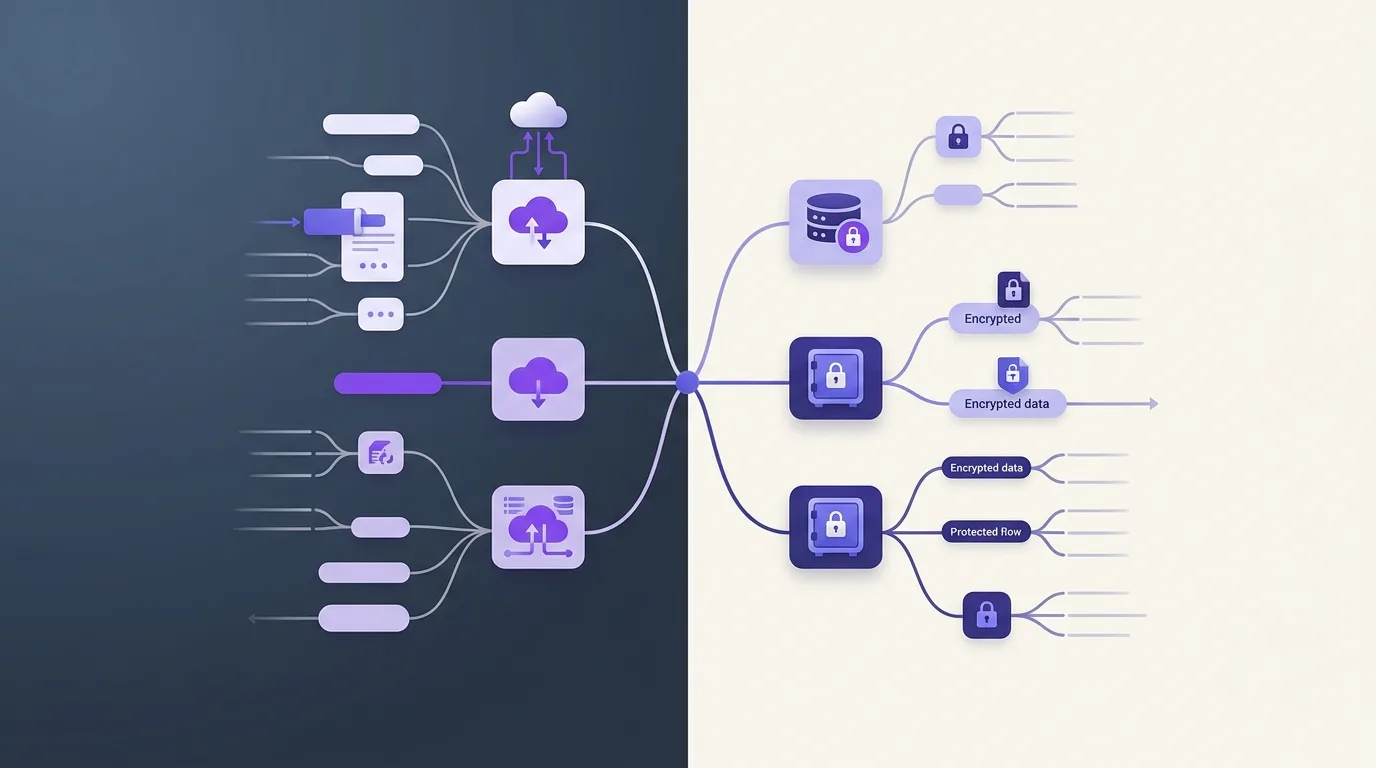
Understanding local-only storage
Local-only storage means your data never leaves your physical device. There is no 'cloud', no 'server', and no 'sync' unless you manually move the files. This is the ultimate form of digital sovereignty.
Good reasons to run locally
- Extreme Privacy: You are working on top-secret projects where even E2EE is a risk.
- No Internet Required: You work in remote areas or high-security buildings without web access.
- Speed: Local file access is always faster than waiting for a network handshake.
The real tradeoffs of local-only storage
While highly secure, local-only means you are solely responsible for backups. If your laptop dies and you haven't backed up to an external drive, your data is gone forever. It also makes 'picking up where you left off' on a mobile phone impossible.
Is local-only right for you?
- Do you primarily work on one device?
- Do you have a robust physical backup strategy?
- Is the risk of cloud exposure higher than the risk of hardware failure?
Understanding local-only storage
Local-only storage means your data never leaves your physical device. There is no 'cloud', no 'server', and no 'sync' unless you manually move the files. This is the ultimate form of digital sovereignty.
Good reasons to run locally
- Extreme Privacy: You are working on top-secret projects where even E2EE is a risk.
- No Internet Required: You work in remote areas or high-security buildings without web access.
- Speed: Local file access is always faster than waiting for a network handshake.
The real tradeoffs of local-only storage
While highly secure, local-only means you are solely responsible for backups. If your laptop dies and you haven't backed up to an external drive, your data is gone forever. It also makes 'picking up where you left off' on a mobile phone impossible.
Is local-only right for you?
- Do you primarily work on one device?
- Do you have a robust physical backup strategy?
- Is the risk of cloud exposure higher than the risk of hardware failure?
Understanding local-only storage
Local-only storage means your data never leaves your physical device. There is no 'cloud', no 'server', and no 'sync' unless you manually move the files. This is the ultimate form of digital sovereignty.
Good reasons to run locally
- Extreme Privacy: You are working on top-secret projects where even E2EE is a risk.
- No Internet Required: You work in remote areas or high-security buildings without web access.
- Speed: Local file access is always faster than waiting for a network handshake.
The real tradeoffs of local-only storage
While highly secure, local-only means you are solely responsible for backups. If your laptop dies and you haven't backed up to an external drive, your data is gone forever. It also makes 'picking up where you left off' on a mobile phone impossible.
Is local-only right for you?
- Do you primarily work on one device?
- Do you have a robust physical backup strategy?
- Is the risk of cloud exposure higher than the risk of hardware failure?