
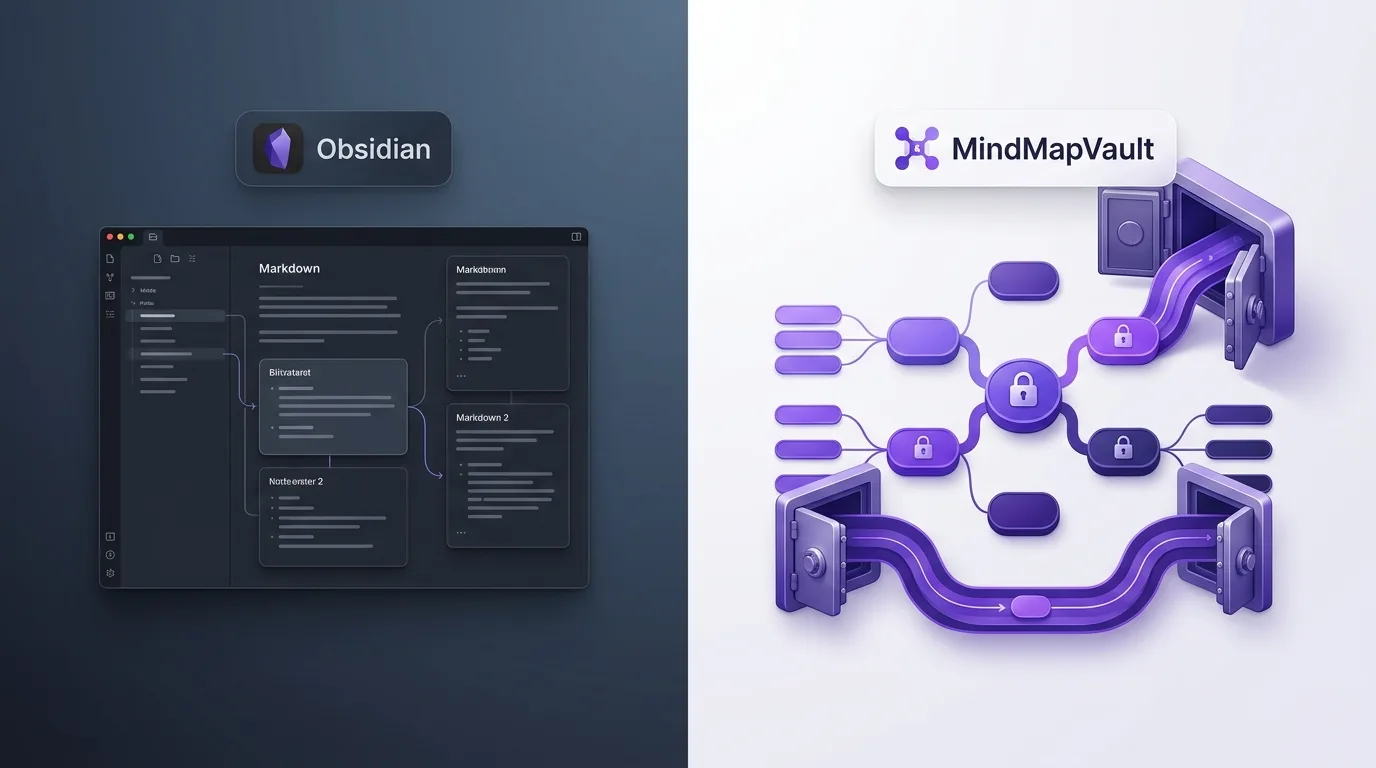
Obsidian Alternative for Private Mind Maps
Short answer
Obsidian is strong when you want a local-first knowledge base built around linked notes, plugins, and personal knowledge management. People usually look for an alternative when they want a more visual mind-map workflow, a simpler privacy story, or a product that starts from private structure rather than from documents.
What Obsidian does well
- Local-first storage is easy to understand.
- Markdown files are durable and portable.
- The plugin ecosystem is broad.
- It works well for people who think in notes, folders, and linked references.
Why someone looks for an alternative
Some people do not mainly think in documents. They think in branches, clusters, relationships, and unfinished structures. In that case, a note-first tool can feel like a workaround instead of a natural workspace.
Another reason is simplicity. A flexible plugin ecosystem is powerful, but it can also shift responsibility onto the user. Some people want fewer moving parts and a clearer privacy boundary from the start.
How MindMapVault differs
MindMapVault is centered on mind maps, notes attached to map structure, and a privacy-first trust model. The question it starts with is not "How do we build a broad PKM platform?" but "How do we let someone think visually without assuming the service can read the result?"
A fair way to choose
Choose Obsidian if you want a local-first knowledge base with flexible note workflows.
Choose a more mind-map-focused alternative if your work is mostly about visual structure, branching thought, and private spatial thinking.
Questions to ask yourself
- Do I think mainly in documents or in visual structure?
- Do I want plugin freedom or a narrower but simpler workflow?
- Is local-first enough for me, or do I also care about a stricter zero-knowledge-style hosted model?